
Ebola: Profits, not wild animals, are driving WHO to declare public health emergencies
Ebola is rare and unlikely to cause a pandemic. Despite this, the World Health Organisation has declared the Ebola outbreak in the Democratic Republic of the Congo and Uganda a public health emergency of international concern (“PHEIC”). The
Ebola is rare and unlikely to cause a pandemic. Despite this, the World Health Organisation has declared the Ebola outbreak in the Democratic Republic of the Congo and Uganda a public health emergency of international concern (“PHEIC”).
The true cause of Ebola outbreaks is unlikely to be wild animals, as claimed by the WHO, but rather gain-of-function research being conducted in laboratories across the globe, including in the regions where these outbreaks occur.
Declaring an outbreak as a PHEIC is an opportunity for pharmaceutical companies and researchers to profit from the development of vaccines and therapeutics.
Let’s not lose touch…Your Government and Big Tech are actively trying to censor the information reported by The Exposé to serve their own needs. Subscribe to our emails now to make sure you receive the latest uncensored news in your inbox…
Stay Updated!
Stay connected with News updates by Email
Ebola: Public Health Crisis or Criminal Enterprise?
By New Zealand Doctors Speaking Out with Science (“NZDSOS”), 29 May 2025
Table of Contents
- Introduction
- What is Ebola?
- Ebola History and Epidemiology
- How is Ebolavirus Disease Diagnosed?
- How is Ebolavirus Treated?
- What Causes an Ebola Outbreak?
- Pandemics Profit Pandemic Prophets
- Conclusion
Introduction
Hot on the tail of hantavirus histrionics, the World Health Organisation (“WHO”) declared on 17 May 2026 that an epidemic of Ebola disease caused by Bundibugyo virus in the Democratic Republic of the Congo and Uganda is a public health emergency of international concern (aka a PHEIC).
As the 79th session of the World Health Assembly wrapped up last week, it is easy to see the priorities of WHO in these four brief headlines from the front page of their website. Without frightening diseases, how will the pandemic agreement be reached, or the global health architecture be built?
What is Ebola?
Ebolavirus belongs to the Filovirus family, named for their thread-like appearance under electron microscopy (“filum” is Latin for “thread”). There are six known subtypes, four of which are associated with human disease. It is claimed that wild animals are the source of initial infection, followed by human-to-human transmission via direct contact with the blood and body fluids of an infected person.
Ebolavirus disease (“EVD”) presents initially as an influenza-like illness, followed by vomiting, diarrhoea, skin rash, impaired kidney and liver function, and impaired neurological status with confusion, irritability and aggression. Internal and external bleeding from any organs can occur, but is less frequent than the aforementioned symptoms.
Ebola History and Epidemiology
According to Laurie Garret in ‘The Coming Plague’ (1994), the first case of EVD was detected in August 1976 in a school teacher from Yambuku in Northern Zaire (now the Democratic Republic of Congo or DRC), near the Ebola river. The subsequent outbreak in this region occurred simultaneously with an outbreak in Southern Sudan. A public health investigation dispatched virologists and epidemiologists from their laboratories in Europe and North America into the deep heart of the African continent.
Tissue specimens were sent to laboratories in Europe and the USA to determine a causative agent. On 10 October 1976, scientists at the Centres for Disease Control and Prevention’s maximum-security laboratory in Atlanta officially informed the World Health Organisation that the causative agent was “a virus that resembles Marburg.“
Serial passage experimentation began almost immediately, “passing Ebola samples from one guinea pig to another to see if the virulence of the virus was diminished as it went through successive generations of animals.” A contamination incident in a UK laboratory resulted in at least one researcher becoming unwell and being successfully treated with plasma from a recovered African patient.
Since that time, there have been more than 25 EVD outbreaks involving the loss of 15,000 lives across a fifty-year timespan. Seventeen of these outbreaks have occurred in the DRC, also currently affected, which was also ground zero for Mpox (formerly known as monkeypox) in 2022. Most outbreaks have been confined to rural areas in five of Africa’s 54 countries: Sudan, DRC, Gabon, the Republic of Congo and Uganda.
The Bundibugyo subtype, responsible for the current public health emergency of international concern (“PHEIC”), was first identified in the Bundibugyo region of Uganda during an outbreak in 2007. A second Bundibugyo outbreak followed in the DRC in 2012, and today’s outbreak is the third involving this subtype.
For context, in the year 2024 alone, tuberculosis killed 1.23 million people and malaria killed 610,000 people. The African continent bears the highest burden of these diseases.
How is Ebolavirus Disease Diagnosed?
Clinical symptoms of EVD are difficult to distinguish from other infectious diseases such as malaria, typhoid fever and meningitis, which are endemic to the geographic region where EVD outbreaks sporadically occur. A range of diagnostic tests has been developed to confirm the presence of Ebolavirus.
The World Health Organisation recommends nucleic acid amplification testing (“NAAT”), of which polymerase chain reaction (“PCR”) is a frequently used technique, with genome sequencing to categorise the subtype. As of 22 May 2026, the Africa Centres for Disease Control and Prevention recommends PCR testing as below.
It is important to always remember the flaws and potential corruptibility in using PCR to diagnose disease, especially when symptoms may be caused by other, more common endemic diseases. Pseudoepidemics can occur in world-class facilities. A much higher risk exists in locations with limited resources and an abundance of sickness and premature death, especially if panic and fear have been galvanised, as we are witnessing today.
How is Ebolavirus Treated?
Early treatment ensures the best possible outcomes, as with any disease. Hydration management via oral or intravenous fluids is important. Monoclonal antibodies may be useful, depending on the subtype. There has been no research into the benefits of repurposed drugs in Ebola treatment but it seems likely that ivermectin and hydroxychloroquine, effective in other RNA virus infections, may be useful. Instead, the World Health Organisation and its sponsors are focused on finding new countermeasures (vaccines and therapeutics) to patent and sell at a profit.
What Causes an Ebola Outbreak?
According to the World Health Organisation, Ebolavirus is “transmitted to people from wild animals (such as fruit bats, porcupines and non-human primates).” Contact with the blood or body fluids of an infected person can then result in human-to-human transmission.
What this assertion ignores, however, is the Ebolavirus gain-of-function research occurring in laboratories across the globe, including across the region where these sporadic outbreaks occur. Such research is always claimed to be for reasons that are in the public’s best interest, for example, to develop countermeasures such as vaccines and therapeutics. Yet the work is shrouded in secrecy.
In a 2015 report on Ebola research at the Commonwealth Scientific and Industrial Research Organisation (“CSIRO”) in Geelong, Victoria, SBS held firmly to the claim that Ebola outbreaks are due to crossover from wild animals. Nevertheless, the same report stated that: “If any of these viruses were to make it out of the lab, it could have deadly consequences.“
In the USA, Rocky Mountain Laboratories in Montana is known to be infecting animals with a range of pandemic-potential viruses, including Ebola. The research involves torturing animals known as maximum-pain virus experiments.
The White Coat Waste Project has exposed a number of biosafety breaches in these laboratories which pose a threat to public health, setting aside the welfare of the animals for a moment.
Late last year, during experimentation with Crimean-Congo Haemorrhagic Fever, a staffer was “bitten by an infected monkey (macaque) that was being tortured (infected and sickened with no pain mitigation).” Earlier this year, Vincent Munster, a virologist at the Rocky Mountain Laboratories, was caught smuggling dangerous pathogens, including Clade 1B Mpox, from the DRC into the USA.
The US Army Medical Research Institute of Infectious Diseases (“USAMRIID”) at Fort Detrick, 50 miles from Washington DC, employs 900 researchers to experiment with “biological threats” including Ebola. USAMRIID developed Ervebo, the first Ebola vaccine, licensed in 2019.
On the African continent, where regulation has even less oversight, a number of laboratories are likely to be involved in gain-of-function research. The proximity of these laboratories to the “ground zero” of outbreaks gives pause for thought to even the least conspiracy-minded amongst us.
In our August 2024 Mpox article, we raised suspicions about the Rodolphe Mérieux Foundation’s high-security facility in Goma, DRC. Situated in North Kivu Province, eastern DRC, Goma lies on the border with South Kivu Province, around 500km from Kamituga, where Clade IB of Mpox was first detected. That alone is a coincidence deserving of raised eyebrows. Even more suspicious is the fact that ground zero of the current Ebola outbreak lies a very similar distance from Goma, in the opposite direction.
The first case of Nipah virus, in a much-publicised outbreak earlier this year, was detected in Kolkata, the provincial capital of West Bengal in India. This is approximately 500km from another Rodolphe Mérieux Laboratory at the Bangladesh Institute of Tropical and Infectious Diseases in Chattogram (Chittagong).
Mérieux Laboratories are partnered with local reference laboratories, academic, university and hospital research institutes across low-income nations in what they named the GABRIEL Network – an acronym for “global approach to biology research, infectious diseases and epidemics in low-income countries.” The stated aim is “to build capacity and improve laboratory-based surveillance of diseases with a major impact on public health in developing countries.” Sponsors include the Bill & Melinda Gates Foundation, among others.
Could this potentially be a front for more nefarious activities? As we documented in March 2026, the Coalition for Epidemic Preparedness Innovations (“CEPI”) was established in 2017 at the World Economic Forum in Davos and received a significant amount of early funding from the Bill & Melinda Gates Foundation. It is a direct institutional descendant of the pandemic preparedness funding architecture documented in the Epstein files.
[Related: Epstein Files Mention Pandemic Simulations Linked to Bill Gates, Tempo, 4 February 2026 and The Epstein Files Illuminate a 20-Year Architecture Behind Pandemics as a Business Model – With Bill Gates at the Centre of the Network, Sayer Ji, 2 February 2026]
In January 2026, CEPI paid $26.7 million to Moderna and the University of Oxford to develop mRNA and viral vector injections that target the Bundibugyo strain. This business decision came just four months before the outbreak began. What are the chances that this timing was coincidental?
One of the many projects listed at the Uganda Virus Research Institute in Entebbe, receiving philanthropic donations from Wellcome Trust and the Bill & Melinda Gates Foundation, is “CEPI: Advancing Global Vaccine Preparedness.” The project claims to conduct “rigorous, standardised testing of vaccine candidates for priority diseases, including Ebola, Marburg, Lassa, Nipah, Rift Valley Fever, SARS-CoV-2, Mpox and unidentified emerging threats,” and to develop and optimise “critical assays for the detection of immune responses against Ebola and Marburg viruses.”
Is it possible that this laboratory is working with live Ebolaviruses? Could that explain the laboratory’s uncanny distance from Bundibugyo, a town and district in western Uganda where the current outbreak strain was first identified in 2007? Bundibugyo and Bunia are about 270km apart, and recent reports claim that the outbreak is spreading in Uganda. Do the Rodolphe Merieux Laboratory in Goma and the Uganda Virus Research Institute in Entebbe have anything to do with these outbreaks that are being blamed on spread following contact with wild animals?
Pandemics Profit Pandemic Prophets
University of North Carolina (“UNC”) Chapel Hill virologist Ralph Baric, considered a pioneer of gain-of-function research, recently had his research grants stopped and was placed on leave by UNC Chapel Hill. This seems to be due to implications of his coronavirus research at the Wuhan Institute of Virology.
In 2018, Baric gave a 40-minute presentation, available on YouTube, in which he prophesied that a pandemic was looming. Many of the people who profit from claims of a pandemic have made similar prophesies. In the clip below, Baric boasted to the audience about the profits that can come from a pandemic. These are consistent with similar boasting from Belgium’s 2009 Swine Flu commissioner at Chatham House in 2019.
[If the video above is removed from YouTube, you can watch it on Rumble HERE. An auto transcription of the first 30 mins of the video is attached below.]
In the current Ebola outbreak, public funds have been committed so far to the tune of US$645 million. With a grand total of 101 confirmed cases, this amounts to $6.3 million per confirmed case. In a nation where the average annual income is US$670, this is obscene and irrelevant to the health or any other needs of the population.
On 24 May 2026, Tedros Ghebreyesus released a video clip on social media announcing the activation of complex networks focused on developing and trialling countermeasures, therapeutics and candidate vaccines. We have written about this Ponzi scheme previously, in which taxpayers cover all risk, the industry receives all benefits and population health remains a very firm loser. The model is explained in this one easy infographic from Dr. David Bell.
Conclusion
A number of viral haemorrhagic fevers are touted as candidates for the repeatedly foretold “next pandemic.“ None evokes more fear than Ebola. This makes it highly marketable despite the fact that it does not transmit easily and outbreaks always ultimately abate naturally.
Ebola is a tiny blip on the landscape of infectious disease threats. Diagnostic practices need to be evaluated closely to ensure that outbreaks are not pseudo-epidemics. Ebola elicits sensation because of the exotic and adventurous nature of Ebola-related research for scientists paid to investigate outbreaks in intrepid locations and to develop “innovative” prevention and treatment technologies. This alone creates a potential conflict of interest in truth-seeking.
Despite the hype, Ebola is very unlikely to be the cause of a pandemic, and so it is unclear as to why someone like Robert Redfield, former CDC Director, would make a claim that “I suspect this is going to become a very significant pandemic.” His financial and other conflicts of interest should be examined closely.
It seems likely that profits, not wild animals, are driving the consecutive public health emergencies of international concern (“PHEICs”) declared back-to-back by WHO, including Ebola. It is clear that exorbitant amounts of money are being injected into Ebola research by the nefarious characters involved in building a global pandemic architecture.
Gain-of-function posing as vaccine research for rare diseases which pose little threat to most people, must be stopped. Disease diagnosis must be held to a standard that respects the diagnostic process as one requiring skilled clinicians referring to a range of appropriate laboratory tests, when necessary, not merely a narrow focus on one single test with potential for misdiagnosis. Fear as a method of control must be removed from all public health strategies and replaced once more with common sense and ethics. Finally, an investigation into the criminality of those attempting to overthrow medicine and public health is required, and appropriate consequences instituted.
Of note: The Focal Points website of the McCullough Foundation is publishing much original investigation into the fear-mongering and flourishing pipeline of these scary viruses and their profiteers.
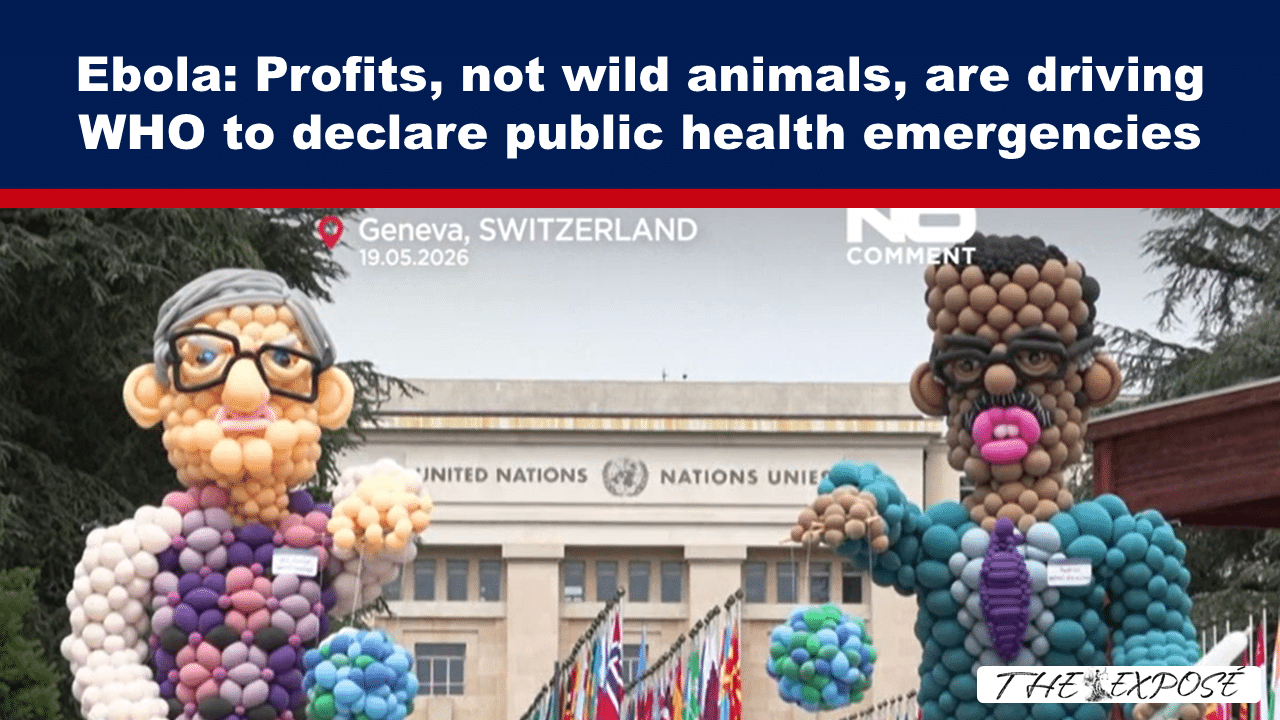
Featured image taken from ‘Activists use giant Tedros and Bill Gates balloons at World Health Organisation protest’, Euro News, 19 May 2026
The Expose Urgently Needs Your Help…
Can you please help to keep the lights on with The Expose’s honest, reliable, powerful and truthful journalism?
Your Government & Big Tech organisations
try to silence & shut down The Expose.
So we need your help to ensure
we can continue to bring you the
facts the mainstream refuses to.
The government does not fund us
to publish lies and propaganda on their
behalf like the Mainstream Media.
Instead, we rely solely on your support. So
please support us in our efforts to bring
you honest, reliable, investigative journalism
today. It’s secure, quick and easy.
Please choose your preferred method below to show your support.
Categories: Breaking News, Latest News, World News
Read the full article at the original website