
Are We in a Free Speech Recession?
For years, debates over hate speech laws have been framed as moral disputes about civility and protection. Increasingly, however, they are becoming legal and political battles over the limits of “free” expression in democratic societies. A
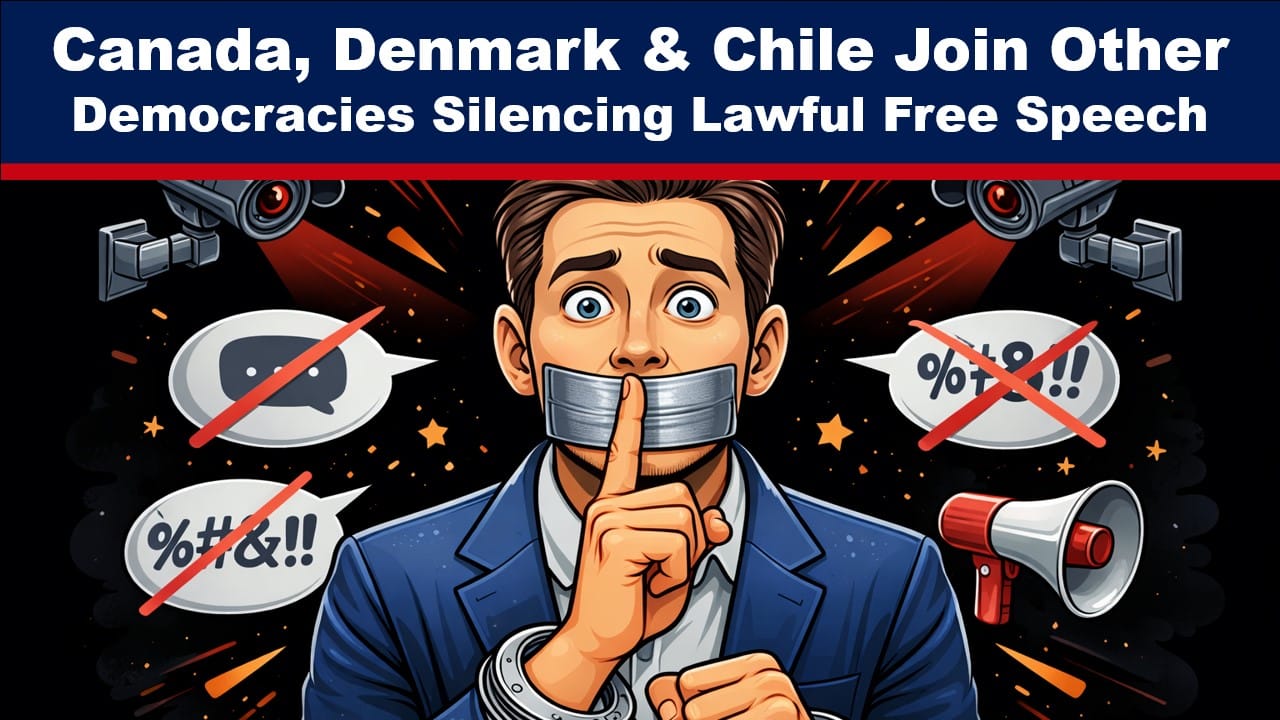
For years, debates over hate speech laws have been framed as moral disputes about civility and protection. Increasingly, however, they are becoming legal and political battles over the limits of “free” expression in democratic societies.
A report by the Future of Free Speech project, titled The Free Speech Recession Hits Home, argues that established democracies are experiencing measurable declines in protections for speech once considered firmly safeguarded. The report contends that restrictions once associated primarily with authoritarian regimes are now expanding across Western countries under the banner of combating hate, misinformation, and extremism.
Hate speech laws are being broadly interpreted all over the Western world, and their continued expansion is reshaping the boundaries of lawful expression.
The Dangerous Global Free Speech Trend
The Future of Free Speech report documents what it describes as a “recession” in expressive liberty within democratic states. According to the findings, more than half of the world’s democracies have seen a decline in protections for speech in recent years, particularly in areas related to hate speech, disinformation, and offensive expression.
The report highlights that while Western Europe has long maintained hate speech statutes, enforcement intensity and definitional scope have broadened. In several countries, the threshold for what constitutes unlawful speech has shifted from direct incitement to broader categories such as insult, denigration, or emotional harm.
The organization’s earlier 2020 Global Handbook on Hate Speech Laws catalogues dozens of jurisdictions with criminal penalties for speech deemed hateful, blasphemous, or defamatory, noting wide variation in definitions and enforcement standards.
The cumulative effect, according to the researchers, is a tightening legal environment in which individuals face increasing uncertainty over what speech may trigger prosecution.
Chile: Journalist Convicted For Highlighting an Official’s “Excessive Pay”
Chile provides a recent example of how restrictions can surface outside Europe and North America. In January 2023, journalist Felipe Soto was convicted of criminal defamation after reporting on what he described as “excessive pay” received by a public official.
According to the Committee to Protect Journalists, Soto was found guilty under Chile’s criminal defamation laws and sentenced to a suspended jail term and fines.
Chile is widely regarded as a functioning democracy with competitive elections and a free press tradition. Yet the use of criminal defamation statutes against a journalist for reporting on public compensation levels underscores how legal mechanisms designed to protect reputations can be deployed in ways that chill investigative reporting.
Free speech advocates argue that civil remedies exist for reputational disputes and that criminal penalties introduce a punitive dimension that risks deterring legitimate scrutiny of public officials.
Denmark: Blasphemy Protections Return
In 2023, Denmark introduced legislation to criminalize the “inappropriate treatment” of religious scriptures, effectively reviving protections reminiscent of the country’s former blasphemy law, which had been abolished in 2017.
The Danish government framed the move as necessary to prevent systematic denigration of religious texts and to protect national security in the wake of Quran-burning incidents.
Critics countered that reinstating penalties for actions involving religious texts marked a reversal in a country previously celebrated for liberal expression norms. The debate in Denmark illustrates how speech restrictions can be justified as pragmatic responses to security concerns, even in societies with strong free speech traditions.
The Future of Free Speech report identifies similar patterns across several democracies, where speech controls expand incrementally under pressure from social unrest or diplomatic tensions.
Canada: Expanding the Scope of “Coercive” Speech
Canada has also become a focal point in discussions about the trajectory of hate speech regulation. Proposed legislation, including Bill C-16 and more recently Bill C-9, has generated debate over the boundaries of protected expression and the scope of state authority.
LifeSiteNews reports that proposed expansions under Bill C-16 would broaden the definition of “coercive or controlling conduct” to include certain non-violent behaviours.
According to Member of Parliament Leslyn Lewis, the proposal “criminalizes a pattern of otherwise lawful and often common behaviour that may later be perceived as threatening by an intimate partner.” She further warned that “ordinary family interactions could be re-interpreted as criminal after the fact.”
Examples cited include questioning a spouse about returning home late, expressing concern over alcohol consumption, disagreements over finances, or enforcing parental boundaries with children.
Supporters of the legislation argue that expanded definitions are necessary to address coercive control in domestic abuse situations. Critics maintain that vague or retroactive interpretations risk criminalizing ordinary speech and private disputes.
The Canadian debate reflects a broader trend identified in the Future of Free Speech report, where governments increasingly rely on categories such as hate speech, disinformation, or psychological harm to justify regulatory expansion.
A Broader Free Speech Pattern Across Democracies
The 2020 Global Handbook on Hate Speech Laws documents that many democracies now impose criminal penalties for speech that insults groups defined by race, religion, gender identity, or sexual orientation. The authors note that while such laws aim to reduce discrimination and violence, they also create enforcement discretion that can be politically contentious.
In parallel, governments have introduced or expanded regulations targeting “terroristic content” and “disinformation,” often granting authorities the power to remove or penalize speech deemed harmful to public order.
The Future of Free Speech report concludes that while no single country has abandoned free expression entirely, the cumulative direction across democracies points toward increased regulation and narrower margins for controversial or unpopular speech.
Final Thought
The debate surrounding hate speech laws is frequently presented as a tension between safeguarding vulnerable communities and preserving long-standing protections for free expression. However, the evidence compiled in recent research suggests that the legal boundaries of speech in democratic societies are evolving in measurable ways.
Legislative changes in Denmark, criminal defamation cases in Chile, and proposed statutory expansions in Canada illustrate how governments are redefining the scope of permissible expression. In each instance, the stated objective is to address harm, discrimination, or social instability. Yet the broader consequence is a gradual recalibration of how speech is regulated within systems historically committed to robust expressive freedoms.
Whether this trajectory represents prudent legal adaptation or a sustained contraction of liberal speech norms will depend on how narrowly these laws are drafted, how consistently they are applied, and how rigorously courts defend constitutional protections. What is beyond dispute is that the parameters of lawful expression in Western democracies are under active revision, and the long-term implications of that revision remain unsettled.
The Expose Urgently Needs Your Help…
Can you please help to keep the lights on with The Expose’s honest, reliable, powerful and truthful journalism?
Your Government & Big Tech organisations
try to silence & shut down The Expose.
So we need your help to ensure
we can continue to bring you the
facts the mainstream refuses to.
The government does not fund us
to publish lies and propaganda on their
behalf like the Mainstream Media.
Instead, we rely solely on your support. So
please support us in our efforts to bring
you honest, reliable, investigative journalism
today. It’s secure, quick and easy.
Please choose your preferred method below to show your support.
Stay Updated!
Stay connected with News updates by Email
Categories: Did You Know?, World News
Read the full article at the original website