
Europe Faces a Strategic Reckoning This Weekend
As leaders gather this weekend at the Munich Security Conference, Europe is set to confront the reality of its long-running “strategic autonomy” claims. With Russia’s war grinding on, US political uncertainty looming, and China repositionin
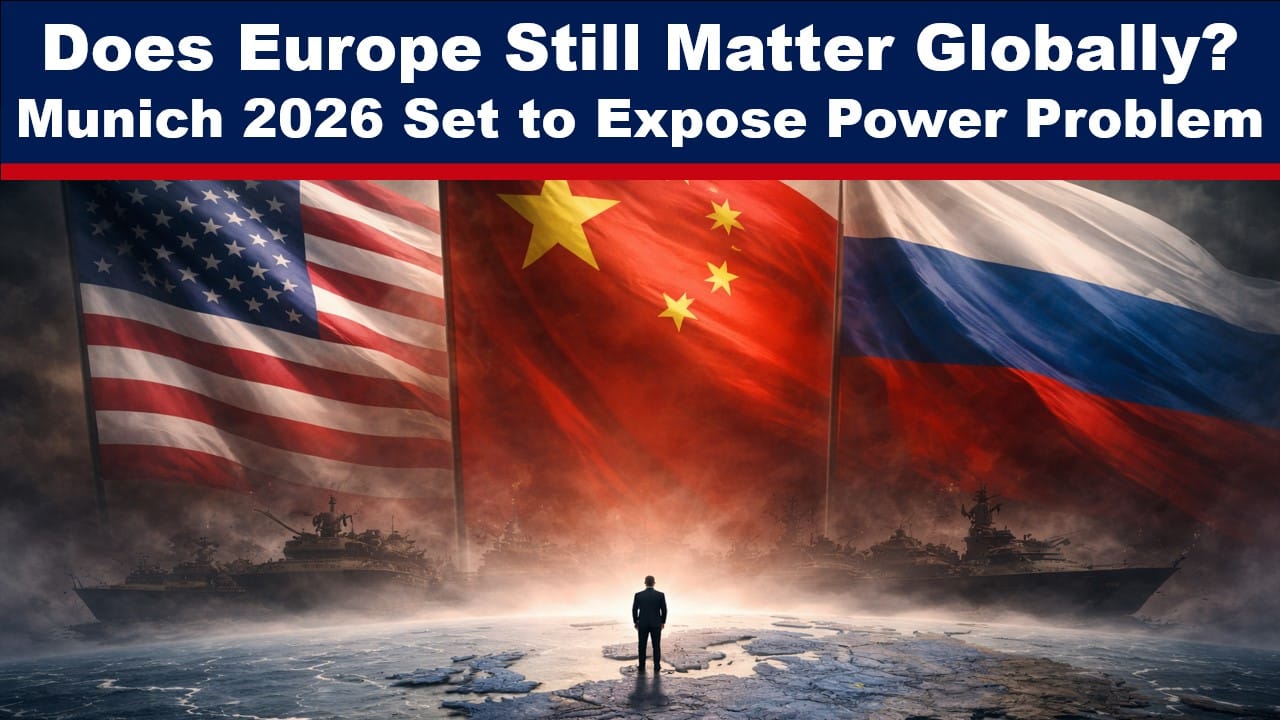
As leaders gather this weekend at the Munich Security Conference, Europe is set to confront the reality of its long-running “strategic autonomy” claims. With Russia’s war grinding on, US political uncertainty looming, and China repositioning itself on the global stage, the conference will force European leaders to answer a simple question: how independent is Europe really in a world dominated by rival great powers?
Munich has become the annual stage where transatlantic tensions surface in public and where the continent’s ambitions are measured against its capabilities. This year, the gap between rhetoric and reality may be harder to ignore.
Strategic Autonomy: Ambition Without Power
The language of strategic autonomy has been promoted most prominently by Emmanuel Macron, who has repeatedly argued that Europe must avoid becoming a subordinate player in a US-China confrontation. The idea suggests the continent is capable of defending itself, shaping its own economic destiny, and negotiating with global powers from a position of strength.
Yet events since 2022 have exposed the limits of that vision. Following Russia’s invasion of Ukraine, European governments turned immediately to NATO, and therefore to Washington, for intelligence, logistics and advanced weapons systems. While European states increased defence spending, their militaries remain fragmented, with procurement systems divided along national lines.
As such, autonomy, in the real world, has remained dependent on American infrastructure.
Europe Continues Relying on US Support, While Pretending to Compete
The United States continues to underpin European security. American military aid and strategic coordination have been central to sustaining Ukraine’s defence. At the same time, economic tensions have emerged.
The US Inflation Reduction Act introduced substantial industrial subsidies aimed at boosting domestic manufacturing and green technologies. European leaders criticised the legislation for disadvantaging EU industries and responded with their own subsidy frameworks and relaxed state aid rules.
The contradiction is stark. Europe relies on American military protection while competing with the United States economically. That dual dependence complicates any claim of genuine independence.
Europe Calls China Both a Rival and Partner: It’s Neither
The relationship with China reflects similar ambiguity. Official EU policy describes China as simultaneously a partner, competitor and systemic rival. This formulation captures a bureaucratic balancing act rather than a coherent doctrine.
China remains one of Europe’s largest trading partners. Key sectors of European industry rely on Chinese supply chains, particularly for critical minerals and battery components. At the same time, concerns over technology transfer, infrastructure investment and geopolitical alignment have grown.
Brussels now speaks of “de-risking” instead of decoupling. The shift in language signals caution without full rupture. Europe seeks to reduce vulnerability while avoiding economic self-harm.
China’s representatives have used past Munich conferences to position Beijing as a stabilising force against Western bloc politics. Whether European leaders accept that framing remains to be seen, but the dialogue itself underscores the continent’s attempt to preserve manoeuvring space between superpowers.
Russia Forces Europe to Learn the True Cost of Dependence
Europe’s rupture with Russia has been the most dramatic geopolitical shift of the past three years. Before 2022, Russian gas was deeply embedded in Europe’s energy system. Sanctions and supply disruptions forced a rapid pivot toward liquefied natural gas imports and renewable energy expansion.
Europe avoided immediate collapse, but at significant cost. Energy prices surged, inflation rose, and industrial competitiveness weakened in some sectors. The episode exposed a structural weakness: European prosperity had relied on inexpensive external inputs.
The war in Ukraine continues to shape this weekend’s Munich agenda. Sustaining military support, financing reconstruction, and maintaining public backing across EU member states are long-term challenges. The burden of leadership is unevenly distributed.
A Continent Distracted by Climate Targets and Mass Immigration
Over the past decade, Europe has invested enormous political capital in climate regulation and social policy expansion. The European Green Deal, carbon pricing regimes, and increasingly stringent emissions standards have reshaped industrial planning across the continent. While environmental transition is presented as moral leadership, it has also raised energy costs, complicated manufacturing competitiveness and introduced regulatory burdens that competitors have not matched at comparable speed or scale.
At the same time, Europe has struggled to manage sustained migration pressures across its external borders. Political divisions over asylum policy, internal burden-sharing, and integration challenges have absorbed domestic attention and strained public finances. The issue has reshaped electoral politics in multiple member states, diverting focus from long-term defence, industrial strategy and technological investment.
During this same period, the United States expanded domestic energy production, revitalised semiconductor manufacturing through targeted subsidies, and accelerated defence modernisation. China pursued coordinated industrial policy, strengthened its naval capacity and expanded influence across supply chains in Africa, Latin America and Asia. Russia, despite sanctions, prioritised military production and strategic depth.
Europe’s priorities have not been trivial. Climate policy and social cohesion matter. However, in an era defined increasingly by hard power, industrial resilience and technological dominance, the continent’s emphasis on regulatory ambition and internal political management has limited its ability to compete at scale. While others consolidated strategic power, Europe refined standards.
The question now confronting European leaders is whether that balance can be sustained in a world where geopolitical competition is intensifying and the margin for strategic error is narrowing.
What We’ll See in Munich This Weekend
The Munich Security Conference is more than diplomatic theatre. It is where Europe publicly defines its security posture and where divergences become visible.
This year’s gathering occurs amid growing uncertainty in US politics, with questions over future American commitments circulating among European officials. It also takes place as China expands its diplomatic outreach and as Russia’s war shows no sign of swift resolution.
European leaders will speak about resilience, sovereignty and unity. They will reaffirm alliances and outline industrial strategies. Yet the structure of Europe’s security environment remains externally anchored.
Munich matters because it compresses these contradictions into a single moment. It is where Europe’s ambition to stand apart must confront the realities of defence spending gaps, industrial dependence and political fragmentation.
What’s Europe Really Trying to Achieve?
Europe is attempting to hedge: It seeks American protection without permanent subordination; it wants economic engagement with China without strategic vulnerability; and it aims to isolate Russia while managing domestic economic strain.
This approach reflects prudence, but also constraint. Europe’s leverage depends on maintaining balance among larger powers whose rivalry is intensifying.
The language of autonomy reassures domestic audiences and signals ambition. Yet autonomy without consolidated military power, energy independence and technological dominance remains aspirational.
Final Thought
As the Munich Security Conference unfolds this weekend, Europe’s strategic identity will be on display. The speeches will emphasise sovereignty and leadership. The alliances will be reaffirmed. The symbolism will be strong.
The deeper question is whether Europe can convert rhetoric into capability. In a geopolitical landscape defined by competition between Washington, Beijing and Moscow, ambiguity carries risks.
Munich will not resolve Europe’s strategic dilemma. But it will make one fact clear: in a world shaped by power blocs, claiming independence is easier than securing it.
The Expose Urgently Needs Your Help…
Can you please help to keep the lights on with The Expose’s honest, reliable, powerful and truthful journalism?
Your Government & Big Tech organisations
try to silence & shut down The Expose.
So we need your help to ensure
we can continue to bring you the
facts the mainstream refuses to.
The government does not fund us
to publish lies and propaganda on their
behalf like the Mainstream Media.
Instead, we rely solely on your support. So
please support us in our efforts to bring
you honest, reliable, investigative journalism
today. It’s secure, quick and easy.
Please choose your preferred method below to show your support.
Stay Updated!
Stay connected with News updates by Email
Categories: Breaking News, World News
Read the full article at the original website