
Seven significant failings of New Zealand’s Royal Commission on Covid
Ian Brighthope lays out seven significant failures of New Zealand’s Royal Commission of Inquiry into the country’s covid response. “No inquiry begins in neutrality when its scope is constrained before the first question is asked. The origin
We have tagged this article as propaganda as it imposes a serious spin on the topic.
If not more explanation provided, this article is included as propaganda because it shows clear manufacture from a government controlled dialectic,
where a topic is misdirected by some actors in order to mislead people during early stages of a narrative.
Ian Brighthope lays out seven significant failures of New Zealand’s Royal Commission of Inquiry into the country’s covid response.
“No inquiry begins in neutrality when its scope is constrained before the first question is asked. The original Phase One Royal Commission was defined by what it excluded … This was not an omission. It was an act of design,” he writes.
And that is just the first of the seven significant failings.
Let’s not lose touch…Your Government and Big Tech are actively trying to censor the information reported by The Exposé to serve their own needs. Subscribe to our emails now to make sure you receive the latest uncensored news in your inbox…
Stay Updated!
Stay connected with News updates by Email
The Trial That Was Never Meant to Happen: An Indictment of New Zealand’s Covid Royal Commission
Click HERE to obtain a free PDF copy of ‘The People’s Position’. Then go to my next Substack for New Zealand’s Health Future.
History will not judge the covid-19 era solely by the virus that spread across nations. It will judge it by the decisions made in its name – and by the willingness, or refusal, of governments to account for those decisions when the crisis had passed. In New Zealand, the mechanism of that accountability was to be the Royal Commission of Inquiry. It was presented as a tribunal of truth. It stands, instead, accused of something far more troubling. Not merely of inadequacy. But of containment.
Count I – Predetermination by Design
No inquiry begins in neutrality when its scope is constrained before the first question is asked. The original Phase One Royal Commission was defined by what it excluded. The most contentious, consequential and ethically charged aspects of the pandemic response were placed beyond its reach: mandates, vaccine safety controversies, censorship, suppression of treatment and the broader legality of emergency powers.
This was not an omission. It was an act of design. An inquiry that cannot examine the central instruments of policy is not an inquiry – it is a perimeter. The later expansion into Phase Two was framed as progress. In reality, it was an admission that the first process had failed to interrogate the core of the crisis. But a system that requires correction after the fact has already demonstrated its original deficiency.
The question must therefore be asked: Was this ever intended to be a full investigation? Or merely the appearance of one?
Count II – Suppression of the Evidentiary Record
A court cannot deliver justice if the evidence before it is incomplete. The Royal Commission operated within an informational landscape that had, for years, been subject to systematic control. During the pandemic, dissenting clinicians were silenced. Researchers were denied funding pathways. Alternative analyses were labelled as misinformation. Public debate was narrowed, curated and, in many cases, extinguished. This was not conjecture – it was observable reality.
Media organisations, supported by state funding, reinforced a singular narrative. Social media platforms amplified official messaging while suppressing deviation. Government agencies monitored and categorised dissent. The result was the creation of an evidentiary vacuum. And into that vacuum stepped the Royal Commission.
It is therefore not enough to ask what evidence the Commission reviewed. One must ask: What evidence was it prevented from seeing?
The very existence of external submissions designed to inform Commissioners of “what they do not know they do not know” is itself an indictment of the process. An inquiry that must be educated about its own blind spots is not operating freely. It is operating within constraints.
Count III – Institutional Capture
No tribunal can claim independence if it draws from institutions that have themselves been implicated in the events under scrutiny. The Royal Commission relied, in significant part, on the same ecosystem that shaped the pandemic response:
- Government departments that authored the policies.
- Regulatory bodies that approved and enforced them.
- Media institutions that amplified them.
- Academic entities that legitimised them.
This is not independence. It is circular validation.
The report highlights how scientific inquiry itself was constrained by funding structures, limiting the scope of permissible research. It documents how dissenting perspectives were marginalised, not debated. When the institutions responsible for a policy are also the primary sources of evidence about that policy, the outcome is predictable: Not scrutiny, but reinforcement.
Count IV – Failure to Confront Ethical Breaches
At the heart of the pandemic response lay a series of decisions that struck directly at the foundations of medical ethics and democratic governance. Informed consent – long regarded as inviolable – was rendered conditional. People faced loss of employment, exclusion from society and restriction of movement if they declined medical intervention.
Medical practitioners who questioned policy were disciplined or silenced. Patient confidentiality was compromised. Human rights were curtailed on a scale unseen in modern New Zealand. These are not marginal concerns. They are the defining ethical questions of the era. And yet, the extent to which they have been fully interrogated within the Royal Commission remains deeply contested. An inquiry that avoids the ethical core of the crisis cannot claim to have examined it. It has, at best, circled it.
Count V – Absence of Proportionality Analysis
Public policy, particularly in times of crisis, must be judged not only by intent but by proportionality. Were the measures imposed justified by the threat? Were alternatives considered? Were the broader harms weighed against the intended benefits? The report raises profound doubts on each of these fronts.
Lockdowns imposed sweeping restrictions with significant social and economic consequences – mental health deterioration, educational disruption, delayed medical care. Yet the evidence for comprehensive cost–benefit analysis remains unclear. If such analyses were conducted, they have not been transparently presented. If they were not conducted, the implications are more serious still. An inquiry that does not demand rigorous justification for the most far-reaching policies in modern history fails in its most basic duty.
Count VI – The Illusion of Accountability
Accountability is not a performance. It is a process of exposure. The Royal Commission has fulfilled many of the procedural elements expected of such a body – hearings, submissions, reports. These create the appearance of scrutiny. But appearance is not substance.
Substantive accountability requires:
- The examination of suppressed evidence.
- The confrontation of institutional failures.
- The willingness to assign responsibility.
Without these elements, the process risks becoming a simulation. A structure that mimics accountability while insulating those it is meant to investigate. This is the gravest charge. Not that the Commission has failed. But that it may have been constructed in such a way that failure was inevitable.
Count VII – The Consequence: Erosion of Trust
The ultimate casualty of a compromised inquiry is not reputational. It is societal. Public trust, once broken, is not easily restored. It cannot be rebuilt through process alone. It requires honesty, transparency and the visible pursuit of truth – especially when that truth is uncomfortable. If the Royal Commission is perceived as incomplete, constrained or unwilling to confront the full reality of the pandemic response, it will not heal divisions. It will deepen them.
And it will reinforce a growing belief that institutions no longer serve the public interest – but their own preservation.
Final Submission – The Case for a True Inquiry
This does not argue that a Royal Commission is unnecessary. It argues the opposite. A genuine, unconstrained, fully empowered Royal Commission is essential. But it must meet a higher standard than what has thus far been demonstrated.
It must:
- Expand its scope without limitation.
- Actively seek suppressed and dissenting evidence.
- Operate independently of institutional narratives.
- Apply rigorous ethical and legal scrutiny.
- Be prepared to assign responsibility where warranted.
Anything less is not justice. It is containment.
Closing Statement
The question before New Zealand is no longer whether an inquiry has taken place. It is whether that inquiry has been allowed to function as intended. A Royal Commission that does not fully investigate is not a safeguard of democracy. It is a mechanism of its preservation – of its image, not its substance. And history is unkind to such mechanisms. Because in the end, truth has a way of emerging.
The only question is whether the truth is revealed by institutions … or in spite of them.
We must investigate the harmful effects of every single vaccine. Parents must be educated that vaccines are “inherently unsafe.” They must be given informed consent and the right of refusal. They must be educated in the roles of vitamin D and other immune-supporting nutrients to protect their children naturally.
Why are vaccine makers the only manufacturers given immunity from prosecution for faulty and dangerous products?
[Brighthope shared two videos clipped from US attorney Aaron Siri’s testimony given to a Senate Homeland Security and Governmental Affairs Committee hearing held on 9 September 2025. We are unable to include the two clips in this article; you can watch them at the end of the article on Substack HERE and watch the full hearing HERE.]
About the Author
Professor Ian Brighthope is an Australian physician with 49 years of practice, an academic, an agricultural scientist and a postgraduate fellowship in nutritional and environmental medicine.
He is the founder and past president of the Australasian College of Nutritional and Environmental Medicine. He has over 40 years of experience in lobbying for reform of the pharmaceutical-dominated medical industry. He is also an honorary council spokesman for The Aligned Council of Australia.
He regularly publishes articles on a Substack page titled ‘Ian Brighthope’s Substack’, which you can subscribe to and follow HERE.
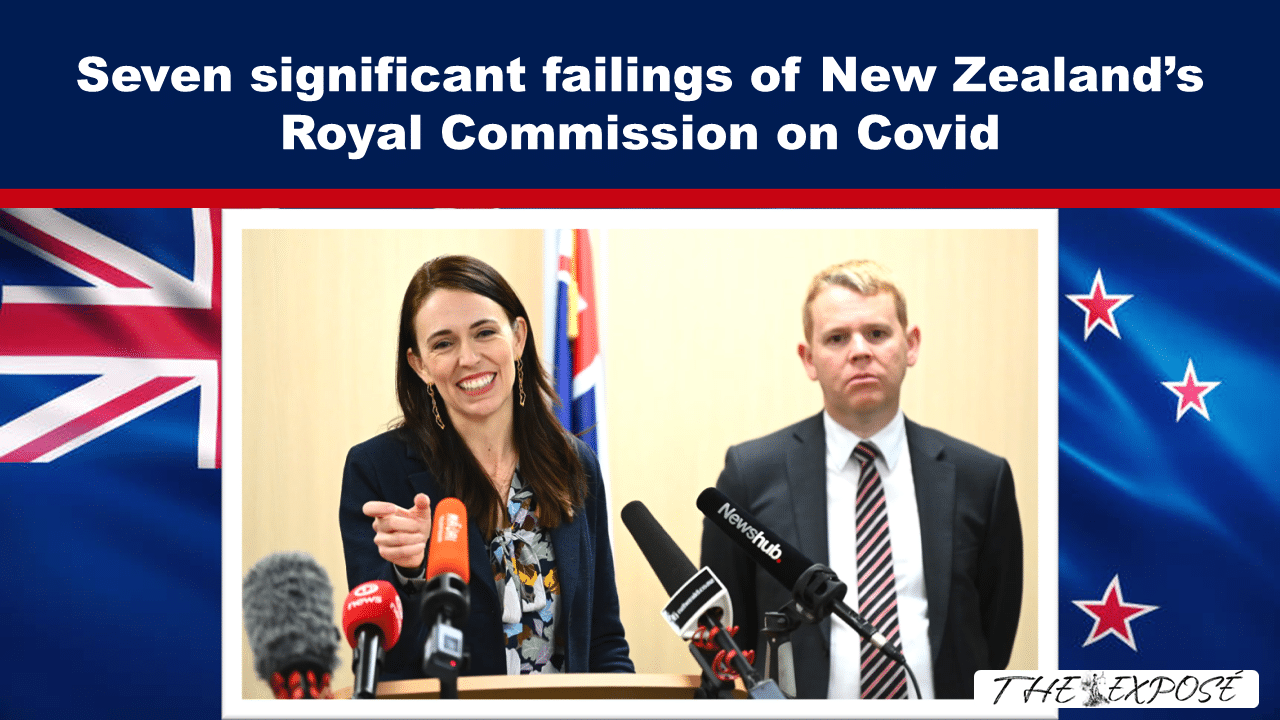
Featured image adapted from ‘New Zealand’s Covid strategy was one of the world’s most successful – what can we learn from it?’, The Guardian, 5 April 2022
The Expose Urgently Needs Your Help…
Can you please help to keep the lights on with The Expose’s honest, reliable, powerful and truthful journalism?
Your Government & Big Tech organisations
try to silence & shut down The Expose.
So we need your help to ensure
we can continue to bring you the
facts the mainstream refuses to.
The government does not fund us
to publish lies and propaganda on their
behalf like the Mainstream Media.
Instead, we rely solely on your support. So
please support us in our efforts to bring
you honest, reliable, investigative journalism
today. It’s secure, quick and easy.
Please choose your preferred method below to show your support.
Categories: Breaking News, World News
Read the full article at the original website