
Of Tariffs, Borders, and Hemispheric Hegemony: Trump’s ‘Donroe’ Doctrine and War on the Cartels
Following is a sober look at developments on the American side of the big pond regarding the US Government which reveals an intriguing, occasionally hopeful, but oftentimes ambiguous and troubling set of affairs as the US observes the 250th
Following is a sober look at developments on the American side of the big pond regarding the US Government which reveals an intriguing, occasionally hopeful, but oftentimes ambiguous and troubling set of affairs as the US observes the 250th year since its birth as a republic via the 1776 Declaration of Independence.
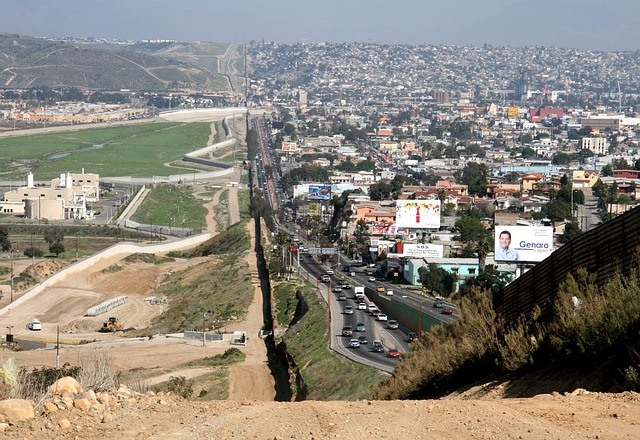
President Donald Trump’s return to power after sitting out for one term under Joe Biden is marked by a highly militant foreign policy, amid Trump’s claims of prodigious peace-making. Yet, on the home front, ‘Trump 47’ apparently has put the US on a more self-sufficient footing, with a stronger industrial base and significantly better border security.
Recent visits by this UK Column writer to the border along the Rio Grande, in Mission, Texas, at the old historic Chimney Park site, where collaborative well-armed Border Patrol and Coast Guard personnel evidently have a solid handle on the overall situation, have helped confirm that illegal entries are way down — perhaps to their lowest-ever levels. Below are two photos from these visits.
Yet, it’s important to take note that tariff and border issues are hybrid in nature, as they involve both domestic and foreign concerns.
Tariffs, properly calculated and fairly administered, can help create a better domestic market for American products by making foreign-made alternatives more expensive for consumers while bringing badly needed revenue into the US Treasury, derived from the importation of certain goods into the US from countries that, despite tariffs, still need the vast US market for selling their wares.
But if they’re enacted on the wrong footing, tariffs can wreak havoc on foreign relations. And border issues, especially those pertaining to the 1,950-mile border between the US and Mexico, are international, or ‘foreign’, by their very nature, but they are typically treated like they’re chiefly domestic in nature.
And while Trump’s tariff policy has been hobbled by the Supreme Court of the United States (SCOTUS) in a recent ruling, does that mean his far-reaching tariffs are going away? And what else can be said about the border?
Well, a 7 March special conference held by ‘Team Trump’ near Miami, Florida, shows that the White House, beyond minding the border itself in a defensive manner, is switching gears in a big way, well beyond the southern border, which has been overshadowed by the events in Iran.
As you read on in this article, these and other key questions will be explored.
Tariffs Are Not Dead
2 April 2026 marks the one-year anniversary of Trump’s press conference in the White House’s Rose Garden, during which he announced that he would compensate for decades of truly massive US trade deficits by levying tariffs on virtually all goods imported into the US.
Amid the Administration’s negotiation and implementation of tariffs on imports from various countries, ranging from China to the UK and several other countries, Trump, the Treasury Secretary Scott Bessant, and the Trade Representative Jamieson Greer have overseen a big jump in tariff revenue flowing into the US Treasury so far, with even higher numbers anticipated.
The stated long-range goal, which is music to most MAGA ears, is to lessen reliance on federal income tax revenue and utilize tariff receipts to run the Government. This, however, cannot be an easy task due to various factors, so to whet the public’s appetite for what lies ahead — and everyone hopes that the word ‘lies’ doesn’t take on the wrong connotation here — the concept of tariff-based stimulus checks has been dangled in front of citizens as they try to navigate the strange new world of ‘Trump-onomics’.
Yet, as of this writing, such largess has yet to become a reality, even though stimulus checks based on tangible manufacturing and trade, in many ways benefit producers who need to sell their inventories to survive.
The High Court Steps In
When the SCOTUS ruled 6-3 on 20 February 2026 that President Trump’s primary reliance on the 1977 International Emergency Economic Powers Act (IEEPA) law to enact tariffs was a constitutional foul ball, the court’s justices basically said that while Trump could utilise IEEPA to enforce trade embargoes and other regulations on foreign commerce if a national emergency involving foreign threats was invoked, IEEPA did not empower Trump to enact tariffs.
However, according to various sources, tariffs — which are often authorised under national security or trade enforcement statutes — are absolutely used as a broad regulatory tool to shape foreign commerce. In other words, tariffs transcend simply generating revenue, functioning as a multi-faceted measure that can discourage excessive imports, protect the home industrial base, and broadly influence behaviour. This is widely understood across the spectrum of opinion.
While a reading of the IEEPA law shows that it is indeed broad — and evidently does not specify ‘tariffs’ in its description of what the president is authorized to do economically to protect America in a proclaimed national emergency — it still gives the sitting president considerable leeway.
And in a nation where constitutional safeguards and principles are routinely broken — a longtime tradition — it’s hardly surprising that the Trump Administration very liberally interpreted IEEPA to mean that tariffs may be among the regulations to choose from for protecting the US during a perceived emergency.
The president can use IEEPA “to deal with any unusual and extraordinary threat, which has its source in whole or substantial part outside the United States, to the national security, foreign policy, or economy of the United States, if the president declares a national emergency with respect to such threat”.
A separate provision of the law says that when there is a national emergency, the president may “regulate … importation or exportation” of “property in which any foreign country or a national thereof has any interest.” So, IEEPA may not mention tariffs in particular, but some may say it implies them.
On 2 April last year, when Trump held that above-noted ‘Liberation Day’ press conference to announce the imposition of a host of tariffs on imports, he felt that a national emergency, of a sort, had been reached regarding the massive trade deficits that the US has been shouldering for as long as anyone could remember — and to some extent still is.
Yet, many argued that while those deficits may at times be exceedingly large, they did not constitute a literal emergency at the level of a more sudden, overtly dangerous, and damaging event like war, for example.
No Payback?
According to the Supreme Court’s official blog, in relation to the Court’s IEEPA decision, it “did not weigh in, however, on whether or how the federal government should provide refunds to the importers who have paid the tariffs, estimated in 2025 at more than $200 billion”.
In Justice Brett Kavanaugh’s lengthy dissenting opinion, he stressed that the US Government “may be required to refund billions of dollars to importers who paid the IEEPA tariffs, even though some importers may have already passed on costs to consumers or others”.
Kavanaugh also warned:
Because IEEPA tariffs have helped facilitate trade deals worth trillions of dollars — including with foreign nations from China to the United Kingdom to Japan — the Court’s decision could generate uncertainty regarding various trade agreements.
The SCOTUS’ blog also recalled that the dispute that led to the 20 February SCOTUS tariff opinion:
… began last year, when Trump issued a series of executive orders imposing the tariffs. One set of tariffs, known as the ‘trafficking tariffs,’ targeted products from China, Canada, and Mexico, which, Trump says, have not done enough to stop the flow of fentanyl into the United States.
The blog also noted:
Another set, known as the ‘reciprocal’ tariffs, imposed an initial tariff of 10% on imports from almost all countries and even higher tariffs on products from dozens of countries. In imposing those tariffs, Trump cited large trade deficits as an ‘unusual and extraordinary threat to the national security and economy of the United States’.
CFR Chimes In
To its credit, the pro-global trade, generally anti-tariff Council on Foreign Relations (CFR) adroitly noted:
[Although] this [SCOTUS] ruling settles an important legal matter, the battle over tariffs is far from over. While American businesses and consumers may cheer the court … [its] decision is likely to be a temporary break in the president’s ongoing trade wars. Congress has delegated several trade authorities to the executive branch over the years. Shortly after the ruling, Trump announced that he’d reach for them to rebuild his tariff wall.
Those optional trade authorities are Sections 122 and 301 of the Trade Act of 1974, Section 232 of the Trade Expansion Act of 1962, and Section 338 of the Smoot-Hawley Tariff Act of 1930.
To immediately replace his 10 percent baseline tariff, Trump promptly announced after the IEEPA ruling that he’d redirect his efforts and utilize Section 122 of the Trade Act of 1974; it authorises the President to address “large and serious” balance-of-payments deficits by imposing tariffs of up to 15 percent, or applying import quotas.
“The statute requires only a presidential determination that such a deficit exists and does not mandate an interagency process or formal investigation,” the CFR noted, adding:
Section 232 of the Trade Expansion Act of 1962 … authorizes the president to impose tariffs or quotas on imports deemed to threaten U.S. national security, following an investigation and recommendations by the Secretary of Commerce. Because the statute does not define 'national security’, it grants the executive branch broad discretion in its interpretation. Trump stated that existing 232 tariffs would remain ‘in full force’.
Cloaked Strategy?
It’s a safe bet that Trump probably planned all along that, if the Court’s IEEPA ruling did not go his way, it would give his tariff opponents a fleeting sense of victory. Clearly, the tariffs allowable through Section 232 tariffs and other measures give Trump plenty of elbow room. So, with one ‘loss’ on his side of the ledger, it may be that his tariffs, whose revenue into the US Treasury reached $30 billion per month by latter 2025, will emerge stronger than ever.
Trump Declares War on Cartels
While our television sets beamed with reports of bombs falling in Iran, a different sort of bombshell erupted in Doral, Florida, near Miami — the Shield of the Americas Summit, held the 7th of March. There, President Trump, flanked by Secretary of War Pete Hegseth, Secretary of State Marco Rubio, Treasury Secretary Scott Bessant and several other top-level officials, inaugurated what amounts to a declaration of war on Latin American drug cartels.
Trump, who hosted heads of state at the summit representing a dozen nations from across the Western Hemisphere, gave remarks that were distilled into a definitive online White House statement which notes that the Summit’s outcome facilitated the creation of the Americas Counter Cartel Coalition. This sweeping move is unprecedented in scope.
The summit included the attendance of the leaders of Argentina, Bolivia, Chile, Costa Rica, Dominican Republic, Ecuador, El Salvador, Guyana, Honduras, Panama, Paraguay, and Trinidad and Tobago. Mexico was notable for its absence of representation.
Shift in Focus
In the wake of reports that Immigration and Customs Enforcement (ICE) agents allegedly engaged in human rights abuses resulting in deaths and injuries during apprehension operations of illegal aliens in Minnesota, Trump’s move to quickly implement this hemispheric plan against the cartels serves to re-direct public attention and show that he’s supposedly serious about getting the truly ‘bad guys’ — people far more worth the Government’s time and money than the sundry illegals living and working in various US states.
Indeed, when Tom Homan was first announced as the new ‘border czar’ upon President Trump getting elected a second time in November 2024, Homan noted that the Government would mainly focus on the most dangerous figures who had entered the US illegally. He apparently meant that the adults and children in the US illegally, but probably not involved in serious crimes, would not be a particularly high priority for deportation — at least not right away.
Trump’s Proclamation
In describing the above-noted ‘Shield’ summit and the resulting Americas Counter Cartels Coalition, that White House statement referenced above boldly says:
The United States, under my leadership, has demonstrated a sustained commitment towards achieving the dismantlement of cartels and foreign terrorists operating in the Western Hemisphere. My Administration has designated a number of cartels and transnational gangs as foreign terrorist organizations and has since dedicated unprecedented resources towards their destruction.
Furthermore, the irony being that the cartels are considered responsible for the very things that modern superpower states themselves routinely engage in, Trump’s statement added:
These international entities control territories and commerce, extort political and judicial systems, wield arms and field military capabilities, and use assassinations and terrorism to achieve their ends.
Anti-Cartel ‘NATO’?
Trump added:
… in furtherance of our efforts, the Secretary of War established the Americas Counter Cartel Coalition, a pledge from military leaders and representatives from 17 countries demonstrating that the region is ready to operationalize hard power to defeat these threats to our security and civilization; we will address these grave dangers … together with our partner nations.
Stepping back and looking at the big picture, one is inclined to ask: Is an anti-cartel ‘NATO’ —geographically consistent with Trump’s recent invocation to resurrect the Monroe Doctrine and police and protect the Western Hemisphere — taking root? In a sense, yes, except for the new coalition is more offensive than defensive.
A noted longtime friend of Trump and contact of this UK Column writer, former Maricopa County, Arizona, Sheriff Joe Arpaio, stated — without any prompting — that he perceived the same basic thing.
“It’s like a little NATO”, Arpaio said, regarding this new coalition of Latin American nations that President Trump apparently has convinced to cooperate with the US in declaring war on the region’s drug cartels.
He also told UK Column: “At least Donald Trump is paying attention to that area — Central and South America”, referring to regions where he himself, during the 1970s as a Drug Enforcement Agency officer, took a proactive approach to stop drugs, miscellaneous contraband (and people intent on making an illegal entry) from getting to the US border in the first place.
When Arpaio was asked if perhaps Trump is borrowing a tactical page from his DEA day, proactively stopping or at least limiting the cartels and their contraband from ever reaching the US border to any significant degree, he declined to take direct credit. But he did add: “When I was there in Central and South America, it was piecemeal. It was not really united, with the president putting the heat on, like he’s doing now”.
Cuba in Crosshairs?
As President Trump noted in his spoken remarks at the Florida summit, the nations in this new coalition will be led by a US military that will be fuelled by spending not merely at the current $1 trillion level, but by upwards of $1.5 trillion, with plans for bringing back battleships, of all things, starting with building 10 of them. Plans for new battleships were initially announced in December 2025.
Trump added that Cuba’s regime is on its last leg and will be brought down. Hegseth then chimed in that this isn’t just the Monroe Doctrine put into action; it’s the ‘Donroe Doctrine’.
Increased US control of the Panama Canal apparently is in the works, too. The overall theme behind this master plan smacks of reviving the latter 1890s and the hemispheric dominance and strong Americanist ethos of the era — early indications even back then that America was already pulling away from its strict Republic-based moorings and beginning to sail into the choppy seas of Empire.
Notably, the Spanish-American War, sparked by perhaps the first major false flag event when the USS Maine was blown up by a mine in the harbour of Havana, Cuba — which, however, was never proven to have come from the hand of Spain — represented a major turning point in US power projection. The normal focus on the Western Hemisphere was breached by military actions that ventured as far away as the Philippines.
However, Trump’s relationships with some Latin American leaders have soured, and his policies have drawn criticism, as some leaders characterised the reported US raid that captured now-former Venezuelan leader Nicolás Maduro as an attack on that oil-rich nation’s sovereignty. Trump has also criticised Mexico’s efforts to fight drug cartels and traded barbs with the president of Colombia. However, following the 3 January Venezuela raid, the two leaders appeared to have patched up their differences.
Noem’s New ‘Shield’ Role
Meanwhile, Department of Homeland Security Secretary Kristi Noem — despite pertinent questions about the way she handled, or perhaps mishandled, a $220 million DHS advertising campaign amid evidence she may have approved it via a no-bid ad contract — had just been ‘fired’ from that post by Trump when she was fast-tracked to a new role as a special envoy for the Shield of the Americas, of all things.
This happened despite allegations that a large percentage of the funds went to an ad agency that had only been existing less than a month, according to US Rep. Joe Negus (D-Colorado), who recently grilled Noem about possible conflicts of interest in the ad campaign. Noem’s final day as head of DHS was slated to be 31 March.
That Florida ‘Shield’ summit took place just as legacy media reported that the US-Israeli war against Iran had escalated. That apparently sparked major movements in energy markets. White House Press Secretary Karoline Leavitt said at a press conference that while the US was drilling at home and “tapping into the new markets in Venezuela”, oil-price spikes were “temporary”.
Thus, the US by all indications is determined to maintain its tariff system while ratcheting up its power closer to home to take on the cartels.
Import tariffs, albeit over a considerable time period, could begin to reduce the US Government’s heavy reliance on income taxes for revenue, and we must remember that all types of taxes act as ‘tariffs’, and can, and usually do, add to the final prices of products and services (e.g. the federal petrol tax adds to the cost of fuel, and business, income, or property taxes add to the cost of various products and services).
And while stepped-up anti-cartel measures may have their place to a certain degree, given the trouble the cartels have stirred up over the last several years — especially recently in Mexico in the form of widely publicised street violence — the members of cartels, some of whom are skilled ex-soldiers, typically have access to rather sophisticated (and often stolen) weapons. They have their share of spies and scouts, and may very well escalate violence and kidnappings of American tourists and others to aggressively defy this degree of government intervention.
So, the central question is whether Trump’s ‘Shield’ coalition will really accomplish what it’s supposed to accomplish, or whether it will ‘kick the hornet’s nest’ and instead spark an increase in cartel violence across Latin America and possibly make the US border with Mexico less safe and secure in the long run.
Wittingly or not, Trump’s Administration has put itself in the position of proving, once and for all, whether its prideful, bold policies in pursuit of a new ‘American Golden Age’ will prove worthy, or whether this whole thing is hubris and ambition on the road to perdition. We can all hope for the best, though, with both eyes wide open.
The seductive doctrine that ‘might is right’, in America and beyond, might at first seem appealing on the fleeting basis of national pride for its own sake, but that doctrine will soon wear thin, and all but certainly fail, unless the increasingly well-informed citizens of the world hold their governments to a higher moral standard that, so far, those governments are failing to uphold.
Read the full article at the original website
References:
- https://www.youtube.com/watch?v=WdJBvH9JrbI
- https://www.npr.org/2025/04/02/nx-s1-5345802/trump-tariffs-liberation-day
- https://bipartisanpolicy.org/explainer/tariff-tracker/
- https://taxfoundation.org/research/all/federal/trump-tariffs-trade-war/
- https://www.supremecourt.gov/opinions/25pdf/24-1287_4gcj.pdf
- https://www.congress.gov/crs-product/R45618
- https://www.law.cornell.edu/uscode/text/50/1701
- https://www.scotusblog.com/2026/02/supreme-court-strikes-down-tariffs/
- https://www.cfr.org/articles/what-trump-trade-policy-has-achieved-liberation-day#chapter-title-0-9
- https://www.congress.gov/crs-product/IF13006
- https://www.sheppard.com/insights/blogs/a-time-machine-and-a-bag-of-hammers-u-s-tariffs-are-not-over
- https://www.govinfo.gov/content/pkg/COMPS-10384/pdf/COMPS-10384.pdf
- https://www.whitehouse.gov/presidential-actions/2026/03/commitment-to-countering-cartel-criminal-activity/
- https://www.navy.mil/Press-Office/Press-Releases/display-pressreleases/Article/4366856/president-trump-announces-new-battleship/
- https://www.history.navy.mil/our-collections/photography/us-navy-ships/battleships/maine.html
- https://www.nytimes.com/2026/02/24/world/americas/trump-sheinbaum-us-mexico-cartel.html
- https://www.independent.co.uk/news/world/americas/us-politics/kristi-noem-doj-perjury-congress-dhs-contract-b2939823.html
- https://www.independent.co.uk/news/world/americas/us-politics/shield-of-americas-kristi-noem-envoy-b2932947.html
- https://neguse.house.gov/media/press-releases/icymi-rep-neguses-consequential-questioning-kristi-noem-200m-taxpayer-funded#:~:text=Washington%2C%20D.C.%20%E2%80%94%20Colorado%20Congressman%20joined%20CNN's,she%20attempted%20to%20evade%20accountability%20regarding%20allegations
- https://www.youtube.com/watch?v=q0QH7sX4a8U